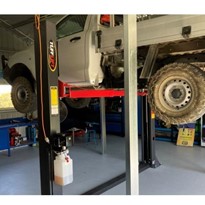


In mining and heavy haulage operations, every truck movement matters. Vehicles transport valuable materials, operate under demanding conditions and need to move efficiently between loading areas, processing facilities and departure points.
But there is a common challenge in truck weighing: knowing a truck's total weight does not necessarily tell you whether its load is properly distributed across its axles.
A vehicle may be within its overall weight limit while one or more individual axles carry excessive loads. Without axle-by-axle measurement, this issue can go undetected.
For operations handling high volumes of truck movements, this creates an important question: how can operators monitor both total vehicle weight and individual axle loads without introducing unnecessary delays?
The Problem: Total Weight Doesn't Tell the Whole Story
Traditional truck weighing processes often focus on obtaining the gross vehicle mass (GVM) or total vehicle weight. While this is important, it may not provide the complete picture of how the load is distributed.
Uneven load distribution can place excessive stress on individual axles, tyres and other vehicle components. It can also contribute to increased maintenance requirements and create challenges for load management.
In mining environments, where heavy vehicles may operate continuously under demanding conditions, identifying these issues early is particularly important.
Operators need a weighing solution that provides more than a single total-weight figure. They need visibility into individual axle loads.
The Challenge: Weighing Trucks Without Slowing Operations
Another difficulty is balancing weighing accuracy with operational productivity.
Conventional weighbridges can require vehicles to stop completely and occupy dedicated space. Depending on the site layout, vehicle volumes and weighing procedures, this can introduce additional steps into the truck movement process.
For busy mining sites, logistics facilities and heavy haulage operations, the challenge is finding a way to obtain reliable weight information while keeping vehicles moving.
A suitable solution should help operators:
Measure individual axle loads and calculate total vehicle weight.
Identify potential axle overloading.
Reduce unnecessary stopping during the weighing process.
Integrate weight data into existing site workflows.
Monitor truck movements without requiring extensive infrastructure changes.
The Solution: Weigh Trucks in Motion with TRAKBLAZE FORCE 1
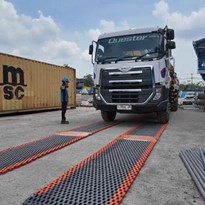
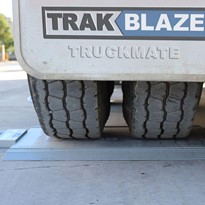
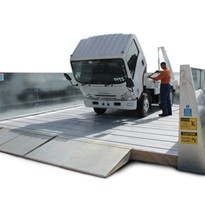
The TRAKBLAZE FORCE 1 Weigh-In-Motion (WIM) Truck Axle Weigher is designed to address these challenges by measuring individual axle loads as trucks pass over the weighing platform.
Rather than requiring every truck to stop for an in-motion weighing process, FORCE 1 allows vehicles to be weighed at speeds of up to 6 km/h.
The system calculates total vehicle weight by summing the individual axle loads, giving operators a more detailed view of the vehicle's loading condition.
1. Identify overloaded axles, not just overweight trucks
FORCE 1 measures individual axle loads, helping operators identify situations where an axle may be overloaded even when the truck's total weight is within the applicable limit.
This additional visibility supports better load monitoring and helps operators investigate potential load-distribution issues.
2. Improve weighing efficiency
With in-motion weighing at speeds of up to 6 km/h, FORCE 1 can reduce the need for trucks to stop completely during the weighing process.
For suitable site layouts and workflows, this can help streamline vehicle movements and reduce interruptions associated with conventional weighing procedures.
3. Achieve accurate weighing performance
FORCE 1 offers the following stated accuracy specifications, subject to site conditions:
Dynamic weighing: ±0.5% GVM.
Static weighing: ±0.05% GVM.
The system is available for both static and in-motion weighing applications, allowing operators to select the appropriate operating method for their requirements.
4. Minimise infrastructure requirements
Installing a weighing system does not always need to involve extensive civil works.
FORCE 1 is designed to require minimal civil works, with installation potentially completed in approximately one day, depending on site conditions and installation requirements.
Its compact, modular design also supports relocation, providing flexibility for operations where weighing requirements or site layouts may change.
5. Connect weighing with broader site operations
Weighing data becomes more useful when it can be incorporated into the wider operational workflow.
FORCE 1 can be configured with optional technologies, including:
Automatic Number Plate Recognition (ANPR) cameras.
RFID tag readers.
Remote LED weight displays.
Stop/go traffic lights.
Automatic boom gates.
SMS weight-data notifications for drivers.
Volumetric scanning systems.
These options can support vehicle identification, driver communication and more integrated weighing processes, depending on the site's requirements.
When combined with a volumetric scanner, the system can also support the measurement of load volume and density, providing additional information for suitable applications.
Where Can FORCE 1 Make a Difference?
FORCE 1 is designed for a range of applications where truck weight monitoring and operational efficiency are important.
Mining operations: Monitor axle loads on heavy vehicles and support better load management in demanding environments.
Heavy haulage: Measure individual axle loads and total vehicle weight to help identify potential overloading issues.
Warehousing and logistics: Weigh trucks before departure to support dispatch procedures and load monitoring.
Industrial facilities: Integrate truck weighing into vehicle entry, exit and material-handling workflows.
The most suitable configuration depends on vehicle types, axle loads, traffic volumes, site conditions and the level of automation required.
A Smarter Approach to Truck Weight Management
Effective truck weighing is about more than knowing how much a vehicle weighs. It is about understanding how that weight is distributed and obtaining the information needed to make better operational decisions.
By measuring individual axle loads and total vehicle weight, FORCE 1 gives operators greater visibility into truck loading conditions while offering an alternative to conventional stop-and-weigh processes.
For mining and heavy haulage operations looking to improve weighing efficiency, identify potential axle overloading and integrate weight monitoring into existing workflows, Weigh-In-Motion technology offers a practical approach worth considering.
Is your current weighing system providing enough visibility into individual axle loads?
Explore the TRAKBLAZE FORCE 1 Truck Axle Weigher and discuss your site's weighing requirements with our team.
TRAKBLAZE Pty Ltd
Australian-designed weighing technology for mining, transport, rail and industrial applications.
Visit: www.trakblaze.com
Email: info@trakblaze.com


-205x205.jpg)



-205x205.jpg)