

Key Takeaways
Straight up or up and over: Scissor lifts raise the platform vertically. Boom lifts slew and reach out, so the base can stay clear of the work area.
Platform space favours scissors: If several workers, tools and materials need to go up together, a scissor lift usually gives you a larger deck.
The 11 metre licence rule: Operators of boom-type EWPs with a boom length of 11 m or more need a high risk work licence. Boom length counts horizontal reach, not just height.
Budget gap: Listed prices on IndustrySearch average about $30,000 for scissor lifts, $65,000 for knuckle booms and $90,000 for telescopic booms.
Ground and access decide the model: Check slope, surface, doorways and indoor emissions limits before you compare quotes.
Safe Work Australia's model Code of Practice: Elevating Work Platforms, published in December 2025, states that many injuries occur because the wrong equipment was selected for the job. NSW was the first state to adopt it, and the SafeWork NSW code took effect on 10 July 2026.
Falls from a height killed 24 Australian workers in 2024, or 13% of all worker fatalities, according to Safe Work Australia.
The core difference: straight up or up and over
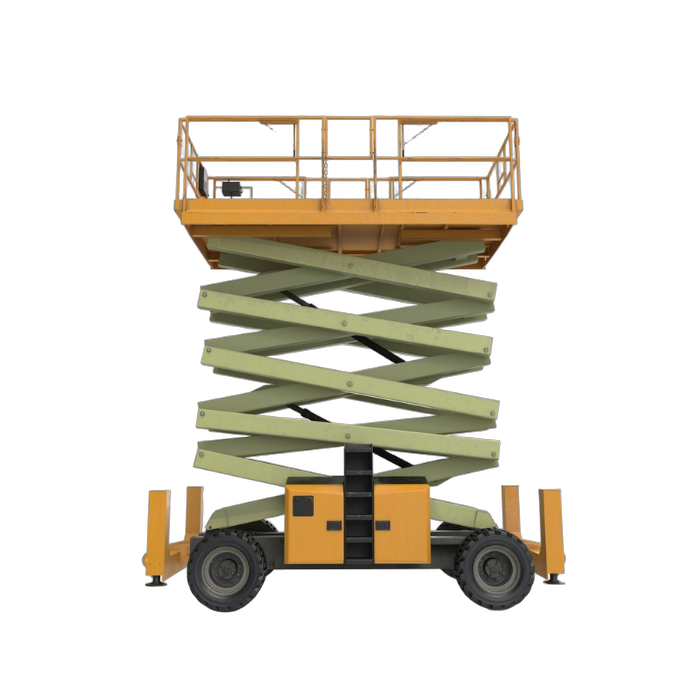
A scissor lift raises its platform on a criss-cross mechanism in an up and down motion only. An extendable deck can roll out past the chassis, but it won't get you over an obstacle.
A boom lift mounts its platform on an arm that slews on a turret. There are two main self-propelled types:
Knuckle (articulating) boom: at least two boom sections joined by a knuckle, so the platform can reach up and over plant, racking or structures.
Telescopic (straight) boom: a single extending boom for long, direct reach where the path to the work is clear.
Scissor lift vs boom lift at a glance
Factor | Scissor lift | Knuckle boom | Telescopic boom |
|---|---|---|---|
Platform movement | Vertical only | Up, out and over obstacles | Up and out in a straight line |
Best suited to | Work directly overhead from a level base | Work behind or above obstructions | Long reach across a clear path |
Platform | Larger deck for a crew and materials | Smaller basket | Smaller basket |
High risk work licence | Not required | Required if boom length is 11 m or more | Required if boom length is 11 m or more |
Full harness on platform | If a risk assessment calls for it | Required | Required |
Listed price range | $10,000-$50,000 | $30,000-$100,000 | $30,000-$150,000 |
Prices are IndustrySearch listing ranges. Rated capacity varies by model, so check the data plate. Some all-terrain scissor lifts listed on IndustrySearch are rated at 750 kg, while one listed 14 m diesel knuckle boom is rated at 230 kg.
Licensing: the 11 metre boom length rule
Workers need a high risk work licence to operate a boom-type EWP where the boom length is 11 m or more, and you must see the licence before they start, according to Safe Work Australia.
Boom length is the greater of two measurements: the height of the platform floor at full elevation, or the horizontal distance from the boom's centre of rotation to the platform's outer edge at full reach. It is taken from the original design, so altering a machine after manufacture doesn't remove the licence requirement.
So a compact boom with a modest platform height can still need licensed operators if its outreach hits 11 m. Scissor lifts aren't boom-type, so no licence applies, but operators must still be trained for the machine. Boom-type EWPs also need design registration.
Five questions that decide it
Can you drive directly under the work? If yes, a scissor lift is usually simpler and cheaper. If plant, racking or a roof edge is in the way, you need a boom.
What needs to go up? List the people, tools and materials with their weights. The code lists both in its selection criteria.
How far out, not just how high? Map the working height and the horizontal distance from where the machine can stand.
What is the ground like? The code warns that a side slope of only two or three degrees can have a drastic effect on stability, particularly with a boom telescoped out. On soft ground, tracked plant with lower contact pressure can help.
Indoors, outdoors or both? For indoor work, the code says to consider electric EWPs because emissions from non-electric machines can be hazardous. Our electric vs diesel scissor lift comparison covers the power choice in detail.
Will it fit? Check doorway widths, aisle widths and floor loading.
Three common scenarios
Warehouse lighting upgrade
A distribution centre is replacing high-bay lights above open aisles on a sealed slab, with two electricians carrying fittings and tools. An electric scissor lift suits the job: a level base, deck space and no exhaust indoors. Lights above racking need a compact electric knuckle boom.
Awning repairs behind a garden bed
An awning sits behind landscaping and a low wall, so a scissor lift can't get close. A knuckle boom parked on the driveway reaches up and over.
Signage across an embankment
A contractor must reach a building's upper wall from the far side of a batter. The line to the work is clear but long, so a telescopic boom fits. Check the set-up ground and the operator's licence.
Buying used? Ask for the paperwork
Suppliers of second-hand EWPs must tell you in writing about the machine's condition and any identified faults. The code recommends requesting the inspection and maintenance history, plus design registration details where required, before you buy.
Check when the major inspection is due. WorkSafe Queensland notes the design life should be 10 years under AS/NZS 1418.10, at which point a strip-down major inspection applies, and earlier for machines worked hard. Factor that into your offer on older units.
What to send suppliers
Maximum working height and horizontal outreach
Number of people, plus tool and material weights on the platform
Obstacles between the base and the work
Ground surface, slope and any soft or backfilled areas
Indoor, outdoor or mixed use, and charging access
Doorway widths, aisle widths and floor loading limits
Whether your operators hold a boom-type EWP licence
Ready to compare? Get quotes on scissor lifts, knuckle boom lifts or telescopic boom lifts from Australian suppliers.
Frequently asked questions
Do I need a licence to operate a scissor lift in Australia?
No high risk work licence applies, but your business must ensure operators have the right training, information and instruction.
Do I need a licence for a boom lift under 11 metres?
Not a high risk work licence, provided the boom length is under 11 m on both the height and outreach measures. Operators still need adequate training.
Can a scissor lift reach over obstacles?
Not the way a boom can. An extendable deck rolls out past the chassis, but the platform still rises vertically. If something sits between the base and the work, choose a boom.




-160x160-state_article-rel-cat.png)




-205x205.jpeg)
-205x205.jpeg)


