
Key takeaways
- Powered roller conveyor: Roughly $500 to $3,000 per metre depending on drive type and zone control.
- A full mid-size system: A 40 m mixed gravity-and-powered system for a mid-size DC typically lands at $40,000 to $100,000.
- What drives price: Gravity versus powered, lineshaft versus motor-driven roller (MDR) zone control, roller pitch, frame width, and the number of merges and diverts.
- The sizing trap: Rated conveyor speed is not system throughput - merges, diverts and accumulation set the real rate, and undersizing forces costly retrofits later.
- The decision: Design to peak throughput, not average, and weigh the system on throughput per dollar rather than the headline price.
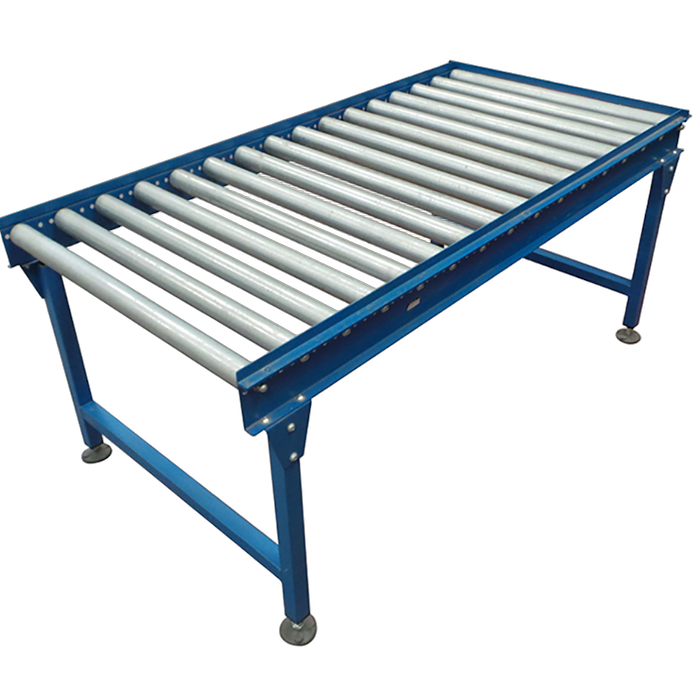
A roller conveyor is deceptively simple: rollers in a frame that carry cartons from A to B. The pricing is anything but, spanning gravity sections that cost nothing to run through to zone-controlled powered systems at thousands of dollars a metre. Get the sizing wrong and even a well-built system backs up at peak and needs an expensive retrofit. This guide covers what roller conveyor costs in Australia in 2026, the running costs behind the quote, and how to size for real output.
Why sizing matters more than price in 2026
The most expensive conveyor mistake is not overpaying - it is undersizing. A system rated to handle your average throughput will back up during the two to three hour peak periods that every distribution centre experiences. Building in a 1.5 to 2.0 times peak factor costs 10 to 20 percent more at installation but avoids $15,000 to $40,000 in retrofit costs later.
The trap is that rated conveyor speed does not equal system throughput. Merges, diverts and accumulation zones set the actual rate, and merge points are the most common bottleneck. A system that looks fast on paper can stall in practice if the transitions are not rated to handle the combined feed volume. That is why sizing, not price, is the first conversation.
Purchase price by configuration
Cost tracks the drive type and how much control the system needs. Here is the practical breakdown:
| Configuration | Typical cost | Best suited to |
|---|---|---|
| Gravity roller sections | Lowest; zero running cost | Flat runs and shallow declines, rigid flat-bottomed cartons |
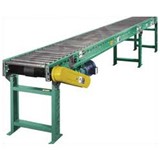
| Powered roller (per metre) | $500 to $3,000 per metre | Controlled transport, accumulation, longer runs |
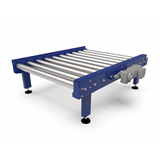
| MDR zone-controlled sections | Adds $20,000 to $50,000 | High sustained throughput, merges without back-pressure |
For context, a mid-size Sydney DC processing 3,000 cartons a day across a 40 m system typically runs $40,000 to $100,000, depending on the mix of gravity and powered sections. Motor-driven roller zone control adds $20,000 to $50,000 but delivers 30 to 50 percent higher sustained throughput than lineshaft equivalents by eliminating back-pressure at merges. The right question is throughput per dollar, not the lowest quote. Browse current listings and pricing among roller conveyors from verified Australian suppliers.
The running costs behind the quote
A conveyor is fixed plant, so budget beyond the hardware:
- Installation and integration: Fitting the system to your floor, matching it to upstream and downstream equipment, and commissioning the controls add materially to the hardware cost.
- Roller attrition: Roller systems have no single large maintenance event but steady roller replacement, typically 5 to 10 percent of rollers a year at $20 to $80 each.
- Energy: Gravity sections cost nothing to run, and even powered roller zones typically draw far less energy than an equivalent belt system because only active zones consume power.
- Safety compliance: Conveyors must meet AS 4024 for machinery safety, covering guarding, emergency stops and nip-point protection, and a plant risk assessment under the WHS Regulations is required for any fixed installation.
As with any fixed plant, the cheapest system on the quote is not always the cheapest to own. A modular system built from bolt-together sections retains resale value and can be reconfigured if your layout changes, which protects its worth across a long service life.
The specs that decide the fit
When you compare quotes, check these against your product and volume rather than the headline number:
- Drive type: Gravity sections use zero energy and suit flat runs. Powered zones draw energy but give control; MDR zones deliver the highest sustained throughput and only power active zones.
- Roller pitch: Rollers must be spaced so at least three support the smallest carton. Mixed carton sizes may need wider pitch or the system loses 15 to 30 percent throughput on the varied mix.
- Merges and diverts: These are the bottleneck. Rate merge points to around 120 percent of the combined feed volume so they do not choke at peak.
- Frame width and load rating: Match to your widest and heaviest carton, with margin for future product changes.
- Modularity: Bolt-together frames and relocatable zones retain resale value and let you reconfigure if your warehouse layout changes.
One decision worth making early is roller versus belt. Roller conveyor suits rigid, flat-bottomed items and costs less to buy and run on flat carton runs; belt is the better choice for loose, bagged, irregular or small items and for steeper inclines. Many operations run a hybrid. The belt versus roller conveyor guide sets out where each earns its place on capability and cost. A conveyor also rarely stands alone: it commonly feeds a carton sealing machine and a pallet wrapping machine at the end of the line, so plan the whole flow together.
A realistic payback scenario
Picture a Brisbane fulfilment centre pushing about 3,000 cartons a day through a mostly gravity system that jams at merges during the afternoon peak. Staff manually clear back-ups, and the bottleneck is capping how many orders ship each day.
Rather than extend the gravity line, the operations lead specs a 40 m mixed system with MDR zone control at the merges, landing around $80,000. The zone control lifts sustained throughput 30 to 50 percent at the transitions that were choking, clearing the peak without extra labour, so the system pays back through the orders it lets the DC ship rather than lose. Because it is built from modular sections, it can be reconfigured when the DC expands rather than replaced. A cheaper extension of the gravity line would have left the merge bottleneck in place, so the system that pays off is the one that fixes the actual constraint.
Frequently asked questions
How much does a roller conveyor cost in Australia?
Powered roller conveyor runs $500 to $3,000 per metre depending on drive type and zone control. A 40 m mixed gravity-and-powered system for a mid-size DC typically lands at $40,000 to $100,000, with MDR zone control adding $20,000 to $50,000.
Why is sizing so important?
Rated speed is not throughput - merges, diverts and accumulation set the real rate. Design to peak throughput at 1.5 to 2.0 times average, or the system backs up at peak and needs a retrofit costing $15,000 to $40,000.
Roller or belt conveyor?
Roller suits rigid, flat-bottomed cartons and costs less to buy and run on flat runs. Belt is better for loose, bagged, irregular or small items and steeper inclines. Hybrid systems combining both are common.
What are the ongoing running costs?
Steady roller replacement at 5 to 10 percent a year, plus energy on powered zones and routine safety maintenance. Gravity sections cost nothing to run, and powered roller zones draw less energy than an equivalent belt system.
What matters most
A roller conveyor is a throughput decision, not a length-of-steel purchase. The system that pays off is sized to your peak, not your average, with merges rated to handle the combined feed and roller pitch matched to your full carton range. Cost it on throughput per dollar rather than the lowest quote, plan for the compliance and roller-attrition costs behind the hardware, and remember that the cheapest system that jams at peak is the most expensive one to run.
Ready to compare configurations and pricing from Australian suppliers? Get quotes on roller conveyors here.