
Key takeaways
- What they cost: Electric tugs on IndustrySearch typically range from around $3,000 for compact cart movers to $30,000+ for heavy-duty tow tractors rated to several tonnes.
- What sets the price: Towing capacity, battery type (lead-acid vs lithium), drive system, and options like remote control and stainless-steel builds are the main cost drivers.
- Where they earn their keep: Sites with repetitive manual pushing and pulling of trolleys, cages, and wheeled loads, where manual handling injuries and labour hours are adding up.
- The hidden number: Look at total cost of ownership, not just the price tag: batteries, charging, and servicing shape the real figure over a decade of use.
- The decision: Size the tug to your heaviest routine load and your worst floor, then choose the battery and control options that match your shifts.
If your team still shoulders trolleys, bins, and wheeled cages across a warehouse or hospital corridor by hand, an electric tug is one of the cheapest pieces of automation you can buy to cut that strain. But "cheap" is relative: prices span an order of magnitude depending on how much you need to move and how you want to move it. This guide walks you through what electric tugs actually cost in Australia in 2026, what drives the price, and how to match a unit to your site before you request quotes.
Why electric tugs are gaining ground
Manual handling remains one of the most expensive risks on any Australian worksite. Body stressing, which includes muscular stress from lifting, pushing, and pulling, is consistently among the leading causes of serious workers' compensation claims, according to Safe Work Australia. Every trolley an operator drags by hand is a claim waiting to happen and a slice of productive time lost.
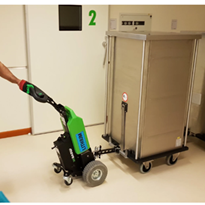
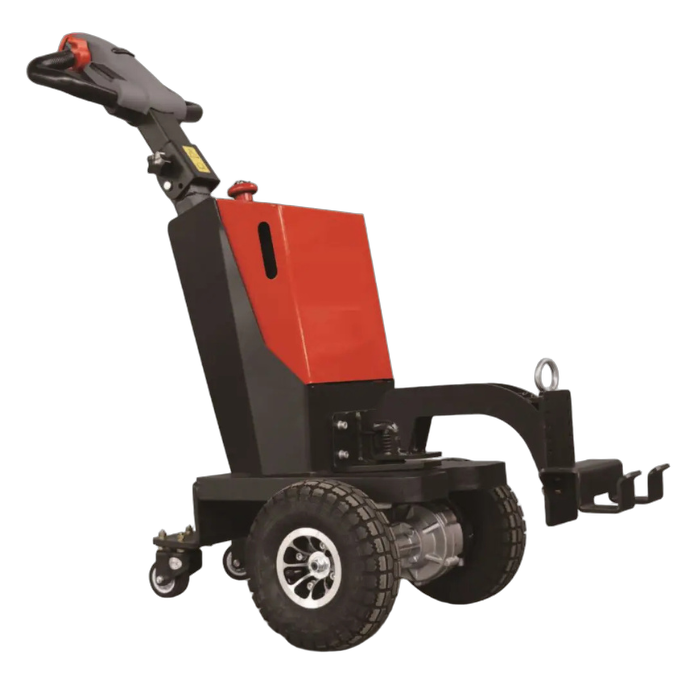
Electric tugs, also called pedestrian tow tugs or tuggers, answer that directly. A single operator walks behind the unit and steers heavy wheeled loads with fingertip controls, removing the strain of manual force. Because they run on batteries with no engine fumes, they suit indoor use in warehouses, hospitals, food production, and cleanrooms, which is where much of the manual handling burden sits.
What an electric tug costs in 2026
Pricing tracks capacity and specification more than brand. As a working guide for the Australian market:
- Compact cart movers (up to ~1,000kg): Roughly $3,000 to $8,000. Ideal for bins, light trolleys, and single-cage transport in retail, healthcare, and light manufacturing.
- Mid-range tuggers (1,000 to 3,000kg): Around $8,000 to $18,000. The volume segment for warehousing and distribution, where a unit like a 3,000kg-rated tug handles linked trolleys or a loaded cage.
- Heavy-duty tow tractors (3,000kg+): $18,000 to $30,000 or more. Built for tugger trains and industrial towing across larger sites, often with electric steer and automation options.
Options push those numbers up. Lithium-ion batteries cost more upfront than lead-acid but enable opportunity charging and longer shift life. Remote control, stainless-steel construction for hygiene-critical settings, and custom coupling attachments all add to the price tag. If you are comparing several capacities and configurations, it helps to compare electric tug quotes from Australian suppliers rather than working from list prices alone.
| Tug class | Typical capacity | Indicative price | Best fit |
|---|---|---|---|
| Compact cart mover | Up to 1,000kg | $3,000 - $8,000 | Retail, healthcare, light trolleys |
| Mid-range tugger | 1,000 - 3,000kg | $8,000 - $18,000 | Warehousing, distribution |
| Heavy tow tractor | 3,000kg+ | $18,000 - $30,000+ | Tugger trains, industrial towing |
The specs that shape the price
When you request quotes, these are the numbers that move the total up or down:
- Towing and pushing capacity: Rate against your heaviest routine load on your actual floor, not the flat-ground maximum. Gradients and rough surfaces cut effective capacity.
- Battery chemistry: Lead-acid is cheaper to buy but needs longer charging and eventual replacement. Lithium-ion costs more but supports fast top-ups between tasks and multi-shift operation.
- Drive and steering: Basic mono-drive units suit lighter loads. Powered or electric steer on heavier tugs reduces operator effort and appears at the top of the range.
- Safety features: A dead-man switch that stops the unit when the operator releases the controls is standard on quality machines. Anti-crush reverse and speed control add safety and cost.
- Build and hygiene: Stainless-steel tugs for food and pharmaceutical cleanrooms carry a premium over standard powder-coated steel.
Will a tug pay for itself on your site?
Walk your operation against these questions before you commit:
- Load type and weight: Are staff regularly pushing wheeled loads over 250kg? That is where manual force becomes a genuine injury risk and a tug earns its place.
- Floor and gradient: Ramps and uneven surfaces demand more torque. Confirm the quoted capacity holds on your worst stretch, not just level concrete.
- Frequency: A tug pays back fastest where the same runs happen many times a shift. Occasional transport rarely justifies the spend.
- Charging access: Plan where the unit charges. Lithium suits sites with no room for a dedicated charging bay and battery swaps.
A realistic scenario
Picture a mid-sized distribution centre in Melbourne where pickers hand-drag loaded roll cages, some over two tonnes, from the pick face to dispatch. Two body-stressing claims in a year have pushed the safety team to act.
A mid-range 3,000kg tugger at around $14,000, fitted with a lithium battery for opportunity charging, lets one operator move a linked pair of cages without manual force. Against the cost of a single serious manual-handling claim, the payback is measured in months, not years. The tug does not replace the picker: it removes the part of the job most likely to hurt them.
For a fuller picture of how these machines fit different operations, the electric tugs in warehousing and logistics guide sets out the safety and efficiency case in more detail.
Frequently asked questions
Do you need a licence to operate an electric tug?
Pedestrian-operated tugs generally do not require a high-risk work licence the way a forklift does, but operators should be trained on the specific unit and your site's traffic management plan. Always confirm current requirements with your work health and safety adviser.
How long does a battery charge last?
It depends on load, gradient, and duty cycle. Many units cover a full shift on a charge, but heavy continuous towing shortens that. Lithium batteries make opportunity charging between tasks practical, which suits multi-shift sites.
Is lithium worth the extra cost?
If you run long or multiple shifts, often yes: faster charging and longer service life can offset the higher purchase price. For single-shift, lighter-duty use, lead-acid may be the better value.
Can one tug pull multiple trolleys?
Yes. Higher-capacity tow tugs are designed to pull a train of linked platforms or cages, which is where they deliver the biggest labour savings over manual handling.
What matters most
An electric tug is one of the lowest-cost, fastest-payback safety investments available to sites with heavy manual handling. The price tag ranges widely, so anchor your choice to your heaviest routine load and your worst floor first, then layer on the battery and control options that match your shifts. Get the sizing right and the machine quietly removes injury risk and labour cost every shift. Get it wrong and an undersized tug stalls on your first ramp.
Ready to compare capacities and pricing on pedestrian tuggers? Get quotes from electric tug suppliers across Australia here.





-205x205.jpg)