
Key takeaways
- New price range: Laser cutting machines in Australia cost $5,000–$500,000+ depending on laser type, power and bed size (2026 pricing).
- Laser type is the first decision: Fiber lasers cut metal; CO2 lasers cut non-metals (acrylic, wood, textiles). Buying the wrong type for your primary material wastes the entire investment.
- Power determines thickness capacity: A 3 kW fiber laser cuts up to 16 mm mild steel; 6 kW reaches 25 mm. Under-powering by one tier costs $5,000–$15,000 in outsourced cutting within the first year.
- Bed size locks your maximum sheet format: The standard 1,500 × 3,000 mm bed covers most fabrication work. Upgrading to 2,000 × 6,000 mm adds $20,000–$50,000.
- If you cut only metal thicker than 3 mm: Fiber is the only viable option. CO2 cannot match fiber's speed or edge quality on mild steel above 3 mm.
- Running costs vary by 40–60%: Fiber lasers use 30–50% less electricity than CO2 and have no gas tube replacement cycle - this compounds into $8,000–$15,000/year savings.
- Compliance: AS 4024.1 (Safety of Machinery), Class 4 laser safety enclosure, fume extraction compliant with WHS Regulations 2017.
Selecting the right laser cutting machine for Australian fabrication
Laser cutting machines are capital equipment where specification errors are irreversible. A fabricator who buys a 2 kW when the job mix demands 4 kW, or a CO2 when the work is predominantly metal, faces either outsourcing the shortfall or replacing the machine within 2–3 years. Both outcomes cost more than specifying correctly the first time.
This guide covers the configuration, specification and supplier decisions for laser cutting machines in Australia. For pricing detail, see the fiber laser cutting machine price guide. If you are comparing suppliers, get quotes for laser cutting machines to see current pricing.
Industries where laser cutting is the standard processing method include:
- Metal fabrication and sheet metal processing
- Signage, display and architectural metalwork
- Automotive and aerospace component manufacturing
- Furniture and fixture manufacturing
- Acrylic, timber and textile processing (CO2)
Choose your laser type
Before comparing models, confirm which laser technology matches your material mix. This is a binary decision that cannot be corrected after purchase.
Type | Key Spec | Best For |
|---|---|---|
Fiber laser | 1–30 kW, 1,070 nm wavelength | Mild steel, stainless, aluminium, brass, copper |
CO2 laser | 40 W–400 W, 10,600 nm wavelength | Acrylic, wood, MDF, textiles, leather, plastics |
Dual-source (fiber + CO2) | Switchable source | Mixed-material workshops needing both metal and non-metal capability |
If 80%+ of your work is metal fabrication, fiber is the only specification that makes operational and financial sense. If your work is primarily non-metal (signage, acrylic, timber), CO2 is correct. Dual-source machines suit operations where the material split is genuinely 50/50.
Fiber laser: Faster cutting speeds on metal, 30–50% lower energy consumption, and no gas tube replacement. The laser source lasts 80,000–100,000 hours. This is the standard for metal fabrication shops in Australia. Browse fiber laser cutting machines to compare current models.
CO2 laser: Superior edge quality on organic materials and better performance on thick acrylic (above 15 mm). The gas tube requires replacement every 2,000–8,000 hours at $2,000–$8,000 per tube, adding a cost layer fiber avoids entirely.
Evaluate the key specifications
With your laser type confirmed, these specs determine whether a given machine meets your throughput and material requirements.
Specification | Typical Range | Buyer Consideration |
|---|---|---|
Laser power (fiber) | 1 kW–20 kW | 3 kW cuts 16 mm mild steel; 6 kW cuts 25 mm. Spec to your thickest regular material plus one tier for growth. |
Bed size | 1,300 × 900 mm to 6,000 × 2,500 mm | 1,500 × 3,000 mm is the Australian standard sheet format. Oversizing wastes floor space; undersizing forces sheet nesting compromises. |
Positioning accuracy | ±0.03 mm to ±0.05 mm | Precision-critical work (aerospace, medical) requires ±0.03 mm. General fabrication tolerates ±0.05 mm. |
Cutting speed (1 mm MS) | 30–60 m/min at 3 kW fiber | Speed determines throughput and cost per part - verify at your specific material and thickness. |
Table exchange system | Single / dual pallet / auto load-unload | Dual pallet cuts load/unload downtime by 40–60%. Auto systems suit 2+ shift operations. |
Fume extraction | Integrated / standalone | WHS obligation - cutting metal and plastics generates hazardous fumes requiring compliant extraction. |
The most common mistake is buying one power tier too low. A shop cutting 12 mm mild steel daily on a 2 kW machine runs 3–4 times slower than a 4 kW unit on the same job, creating a throughput bottleneck that costs more in lost productivity than the power upgrade.
Understand the full cost breakdown (2026 prices)
Purchase price is only part of the picture - assist gas, electricity, consumables and maintenance vary significantly by laser type and power.
Category | Price Range (AUD) | Typical Configuration |
|---|---|---|
Entry-level fiber (1–2 kW) | $50,000–$120,000 | Single table, 1,500 × 3,000 mm bed, basic controller |
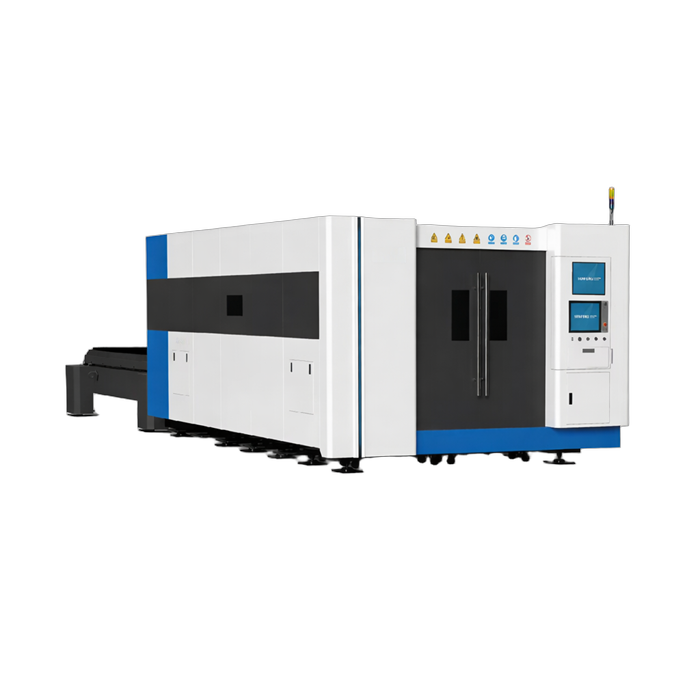
Mid-range fiber (3–6 kW) | $120,000–$250,000 | Dual pallet, auto focus, enclosed safety cabin |
High-spec fiber (8–20 kW) | $250,000–$500,000+ | Auto load/unload, rotary tube cutting, full automation |
CO2 (40–400 W) | $5,000–$80,000 | Single table, various bed sizes, non-metal applications |
Annual consumables (fiber) | $8,000–$25,000 | Nozzles, lenses, assist gas (nitrogen/oxygen), filters |
A mid-range 4 kW fiber laser running single-shift at 2,000 hours per year costs $30,000–$45,000 annually in consumables, electricity and maintenance. Payback depends on whether you are replacing outsourced cutting: shops spending $8,000–$12,000/month on outsourced work typically recover the machine cost within 12–18 months. If you are within 6 months of purchasing, get quotes for laser cutting machines - lead times run 6–10 weeks.
Plan the asset - depreciation and financing
The ATO effective life for laser cutting equipment is typically 10–15 years depending on classification. Under diminishing value at 10 years, the annual rate is 20%. A $200,000 machine writes off $40,000 in year one. The instant asset write-off threshold of $20,000 covers only entry-level CO2 units.
A $180,000 mid-range fiber laser financed over 5 years at 6–8% runs $3,400–$3,800 per month. For shops replacing $10,000+/month in outsourced cutting, the machine is cash-flow positive from month one. Equipment lease and chattel mortgage are the most common structures for laser purchases in Australia.
Evaluate suppliers
You are ready to go to market. Use this checklist to compare laser cutting machine suppliers on equal terms.
Factor | What to Ask |
|---|---|
Laser source brand | Who manufactures the laser source (IPG, Raycus, MAX, nLIGHT)? What is the warranty on the source? |
Cut sample testing | Can you cut my specific materials at my required thicknesses before I commit to purchase? |
Installation and commissioning | Is delivery, installation, alignment and commissioning included in the quoted price? |
Operator training | How many days of training are included? Does it cover nesting software and machine maintenance? |
Service and support | Do you have Australian-based service technicians? What is the guaranteed response time? |
Spare parts | Are nozzles, lenses and protective windows stocked locally or shipped from overseas? |
Software | What nesting and control software is included? Are updates and licences ongoing costs? |
Fume extraction | Is a compliant fume extraction system included or quoted separately? |
Warranty coverage | What does the warranty cover - laser source, motion system, controller, consumables? |
Upgrade path | Can the laser source be upgraded to higher power in future, or does it require full machine replacement? |
Australian compliance requirements
- Laser cutting machines must comply with AS 4024.1 (Safety of Machinery) including guarding, emergency stops and risk assessment documentation.
- Class 4 laser safety enclosure is mandatory. The operator must not be exposed to direct or reflected beam radiation during operation.
- Fume extraction is a WHS obligation under WHS Regulations 2017. Metal and plastic cutting generates hazardous particulate requiring compliant extraction and filtration.
- Electrical installation must meet AS/NZS 3000 and be performed by a licensed electrician. High-power fiber units require 3-phase power supply.
Frequently asked questions
What laser power do i need for general metal fabrication?
A 3–6 kW fiber laser covers 90% of general fabrication work on mild steel up to 20 mm, stainless up to 12 mm and aluminium up to 10 mm. Spec one tier above your current maximum regular thickness for growth.
When should i choose CO2 over fiber?
When your primary materials are non-metallic: acrylic, timber, MDF, textiles or leather. CO2 delivers superior edge quality on these materials at a fraction of the cost of a fiber system.
What floor space does a mid-range fiber laser require?
A 1,500 × 3,000 mm bed machine with dual pallet typically requires 8–10 m × 4–5 m of floor space including service access. Add space for fume extraction ducting and sheet storage.
How long does operator training take?
Most suppliers include 3–5 days of on-site training covering machine operation, nesting software and basic maintenance. Operators with CNC experience typically reach full productivity within 2–4 weeks.
What assist gas do i need and how much does it cost?
Nitrogen for clean-edge cutting on stainless and aluminium ($3,000–$8,000/year); oxygen for mild steel ($1,500–$4,000/year). Gas cost is the largest consumable line item after electricity. See the CNC equipment price guide for comparative running cost benchmarks across CNC machinery.
What matters most
- Laser type (fiber vs CO2) is a binary, irreversible decision - match it to your primary material.
- Power determines thickness capacity and cutting speed - under-specifying creates a throughput bottleneck that costs more than the upgrade.
- Mid-range fiber lasers (3–6 kW) at $120,000–$250,000 cover 90% of general fabrication work in Australia.
- Shops replacing outsourced cutting at $8,000–$12,000/month typically recover machine cost within 12–18 months.
- Always request a cut sample on your specific materials before committing to purchase.
Most buyers shortlist 2–3 suppliers after comparing initial quotes and cut samples.
Do not waste time contacting suppliers individually. IndustrySearch gives you direct access to verified Australian laser cutting machine suppliers - where industrial buyers request and compare multiple quotes so they can buy with confidence.
- Get quotes for laser cutting machines - contact multiple verified suppliers with a single enquiry
- Compare models - filter by laser type, power and bed size
- Contact suppliers directly - speak to specialists who service your state
? Get and compare laser cutting machine quotes now ?