
Key takeaways
- Price range: Jib cranes cost $3,000-$50,000+ (crane only); overhead cranes cost $2,200-$500,000+ in Australia (2026). Installed costs widen the gap further.
- Core difference: Jib cranes serve a single workstation within a defined arc (2-8 m radius). Overhead cranes cover an entire building bay or production line (spans of 5-30+ m).
- If your lifting is confined to one station with a radius under 8 m: a jib crane costs 50-80% less than an overhead crane at the same capacity. If lifting spans a full bay or production line: only an overhead crane provides the coverage.
- Installation complexity: Jib cranes require a concrete foundation or structural wall. Overhead cranes require runway beams along the full building length - a significantly larger structural project.
- Capacity range: Jib cranes typically cover 0.1-5 tonnes. Overhead cranes cover 1-100+ tonnes.
- Compliance: Both must comply with AS 1418.1 and AS 2550.1. Overhead cranes above 10 tonnes may require a licensed crane operator.
Jib crane vs overhead crane Australia (2026): Coverage, capacity, installed cost and the right lifting solution for your facility
Jib cranes and overhead cranes are both fixed lifting systems installed in Australian workshops, factories and warehouses. Both eliminate manual handling, improve lifting safety and increase throughput. But they solve different coverage problems: a jib crane works a single station; an overhead crane works an entire bay. Specifying an overhead crane for a task a jib handles wastes $30,000-$300,000 in unnecessary infrastructure. Specifying a jib crane where full-bay coverage is needed creates manual handling gaps across the rest of the floor.
This guide compares coverage, capacity and cost so you can specify the right system. To compare pricing, get quotes for jib cranes or get quotes for overhead cranes on IndustrySearch.
Facilities where this decision drives the lifting investment:
- Manufacturing plants deciding between bay-wide or station-specific lifting
- Engineering workshops adding heavy lifting at machine tools or assembly stations
- Warehouses with specific heavy-item loading points vs full-bay coverage needs
- New facility fit-outs designing the lifting layout from scratch
Choose your coverage requirement
Before costing anything, confirm whether your lifting coverage is localised or bay-wide. Your answer determines the system type.
Factor | Jib Crane | Overhead Crane |
|---|---|---|
Coverage area | Single station, 2-8 m radius arc | Entire building bay, 5-30+ m span |
Capacity range | 0.1-5 tonnes | 1-100+ tonnes |
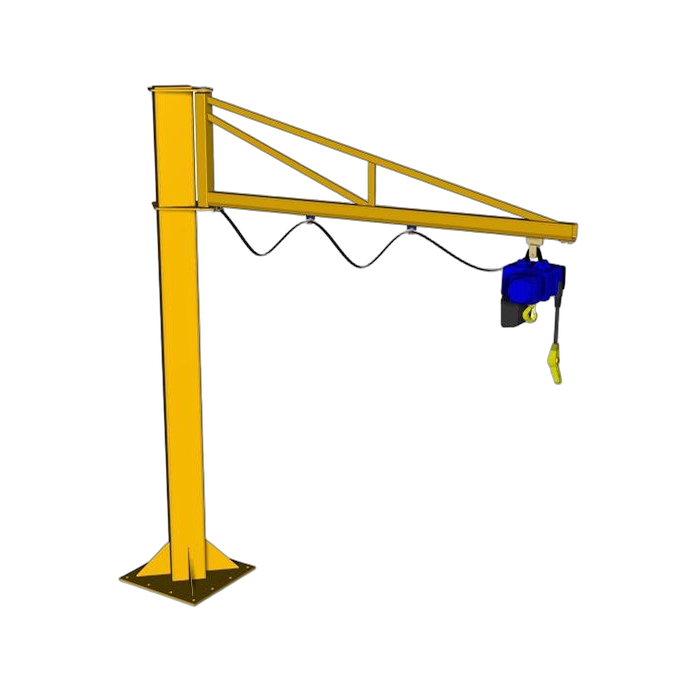
Movement pattern | Rotational arc around a fixed mast | Linear travel along runway beams + cross-travel on bridge |
Building modification | Foundation pad or wall reinforcement | Runway beams, columns, building structural upgrade |
Installation timeline | 1-3 weeks typical | 4-12 weeks typical |
Installed cost (mid-range) | $14,000-$38,000 | $50,000-$200,000 |
If your lifting serves 1-2 defined points within an 8 m radius, a jib crane is the cost-effective solution. If loads must travel the length of a building bay or serve multiple stations across a production line, only an overhead crane provides the required coverage.
Jib cranes are the fastest and cheapest fixed lifting installation. A standard pillar jib can be operational within 1-3 weeks of order including foundation work. They are ideal for adding lifting at individual stations without modifying the building structure.
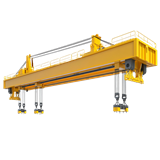
Overhead cranes require runway beams running the length of the bay, supported by columns or the building's structural frame. This is a structural project that typically requires engineering certification, council approval for structural modifications and 4-12 weeks of lead time.
Evaluate the key specifications
With your system type confirmed, these are the specs that separate models within each category.
Specification | Typical Range | Buyer Consideration |
|---|---|---|
Duty classification | M1 to M8 (both) | M3-M5 covers most workshop and production use. Specify based on daily lift cycles, not just capacity |
Hoist speed | 2-12 m/min | Faster hoists reduce cycle time on high-frequency stations but cost more |
Hook height | 2-15 m | Jib cranes are limited by mast height. Overhead cranes by building clear height under the bridge |
Span (overhead only) | 5-30+ m | Must match the bay width. Wider spans require heavier bridge construction |
Travel speed (overhead) | 20-60 m/min | Higher travel speeds reduce cycle time in long bays but increase cost and runway wear |
The most common mistake is installing multiple jib cranes across a production line when a single overhead crane would provide continuous coverage at lower total cost. If your facility needs lifting at 3+ stations along the same bay, get a comparative quote for one overhead crane versus three jib cranes before committing.
Understand the full cost breakdown (2026 prices)
The installed cost gap between jib and overhead cranes is driven by structural infrastructure, not crane hardware alone.
Category | Jib Crane (AUD) | Overhead Crane (AUD) |
|---|---|---|
Light-duty (0.5 t / 5 t) | $5,000-$14,000 installed | $15,000-$50,000 installed |
Mid-range (1-2 t / 5-10 t) | $14,000-$38,000 installed | $50,000-$200,000 installed |
Heavy-duty (3-5 t / 10-50 t) | $35,000-$65,000+ installed | $100,000-$500,000+ installed |
Annual inspection | $300-$800 | $500-$2,000 |
Annual maintenance | $200-$700 | $1,000-$5,000 |
A 2 tonne jib crane installed at $25,000 versus a 5 tonne overhead crane installed at $80,000 represents a $55,000 saving - but only if the jib's coverage area is sufficient. If the overhead crane serves a full production line that would otherwise need 3 jib cranes at $25,000 each ($75,000 total), the overhead crane is the better investment. Get quotes for jib cranes and overhead cranes to compare installed pricing for your specific bay layout.
Decision framework - jib crane vs overhead crane
Decision Factor | Choose Jib Crane | Choose Overhead Crane |
|---|---|---|
Coverage needed | 1-2 stations, radius under 8 m | Full building bay or production line |
Maximum load | Under 5 tonnes | Over 5 tonnes or up to 100+ tonnes |
Building modification appetite | Minimal - foundation pad only | Significant - runway beams, columns, structural certification |
Timeline | 1-3 weeks | 4-12 weeks |
Budget | $5,000-$65,000 installed | $15,000-$500,000+ installed |
Future expansion | Station-by-station as needed | Full bay covered from day one |
Evaluate suppliers
You are ready to go to market. Use this checklist to get comparable quotes.
Factor | What to Ask |
|---|---|
Both types quoted | Can the supplier provide installed pricing for both jib and overhead crane options? |
Site survey | Does the supplier conduct a site survey before quoting to assess structural requirements? |
Engineering certification | Does the quote include structural engineering and AS 1418.1 compliance certification? |
Installation scope | Is foundation, erection, electrical and load testing included in the quote? |
Warranty | What is the structural and hoist warranty? Are runway beams warranted separately? |
Service | Does the supplier provide ongoing inspection and maintenance services? |
Parts | Are hoist components, wheels and electrical parts held in Australian stock? |
Lead time | What is the total project timeline from order to handover for each system type? |
Training | Does the supplier provide operator training at commissioning? |
Frequently asked questions
When is a jib crane cheaper than an overhead crane for the same lifting task?
A jib crane is 50-80% cheaper when lifting is confined to 1-2 stations within an 8 m radius. The saving comes from eliminating runway beams, columns and the structural engineering required for an overhead crane.
At what point does an overhead crane become better value than multiple jib cranes?
When 3+ lifting stations are needed along the same bay, a single overhead crane often costs less than 3 separate jib installations and provides continuous coverage between stations.
Do both systems require the same inspection schedule?
Both require annual competent person inspection under AS 2550.1. Overhead cranes have additional runway and wheel alignment inspections that increase the annual cost to $500-$2,000 versus $300-$800 for a jib.
Can i add jib cranes to a facility that already has an overhead crane?
Yes - many facilities use both. Jib cranes at individual workstations handle light, frequent lifts while the overhead crane handles heavy loads and bay-to-bay transport. This combination is common in Australian engineering workshops.
Which system requires more building modification?
Overhead cranes require runway beams, support columns and often structural upgrades to the building frame. Jib cranes require only a foundation pad or wall assessment - significantly less building disruption.
What matters most
- Coverage area is the deciding factor: single station = jib crane; full bay = overhead crane
- Installed cost gap is 3-10x: do not specify an overhead crane for a task a jib handles
- Compare 3+ jibs vs 1 overhead: if you need lifting at multiple stations in one bay, quote both options
- Building modification scope drives the real cost difference: jib = foundation only; overhead = runway infrastructure
- Both systems work together: many facilities combine jibs at stations with an overhead crane for bay coverage
Most buyers shortlist 2-3 suppliers after getting comparative installed pricing for both system types.
Don't waste time contacting suppliers individually. IndustrySearch gives you direct access to verified Australian crane suppliers - where industrial buyers request and compare multiple quotes so they can buy with confidence.
- Get quotes for jib cranes - contact multiple verified suppliers with a single enquiry
- Compare models - filter by capacity, configuration and region
- Contact suppliers directly - speak to specialists who service your state
? Get and compare jib crane quotes now ?