Static vs Dynamic Checkweighers: Australian Buyer's Guide to Types, Specs and Costs
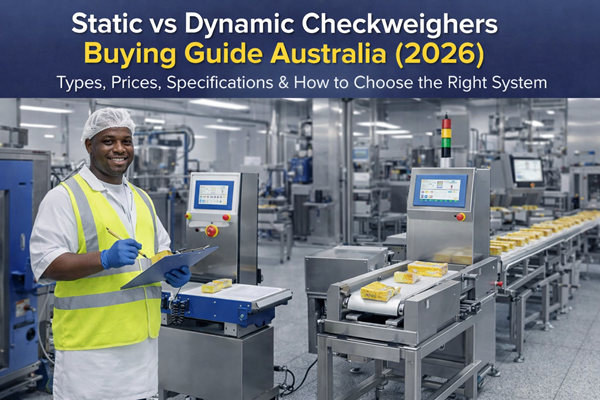
Manual weight checks create two problems that scale badly: they can't keep pace with production lines running hundreds of units per hour, and they don't satisfy NMI auditors. A checkweigher — either a static bench unit or a dynamic in-line conveyor system — solves both. Static models weigh products at rest for high-precision QC sampling; dynamic models weigh every product at line speed and automatically reject out-of-tolerance packs.
This guide is for production managers, packaging line operators and procurement leads deciding between static and dynamic checkweighing, or comparing suppliers for the first time.
Key Takeaways
| Factor | Guidance |
|---|---|
| Static checkweigher price (AUD) | $2,000–$10,000 for bench-top and industrial QC systems |
| Dynamic checkweigher price (AUD) | $15,000–$120,000+ depending on speed and integration |
| Dynamic throughput range | 100–400+ products per minute |
| Static accuracy advantage | Higher single-measurement precision — products weighed while stationary |
| Key cost drivers | Conveyor speed, load cell grade, reject mechanism, washdown construction |
| Australian compliance | NMI Average Quantity System (AQS) governs pre-packaged weight tolerances |
| Typical upgrade trigger | Production volumes outgrow manual or static inspection capacity |
| Maintenance cycle | Annual calibration minimum; conveyor belts and bearings replaced every 2–4 years |
What Is a Checkweigher?
A checkweigher is a weighing system that verifies individual product weight against a declared target — automatically flagging or rejecting packs that fall outside tolerance. Two core terms to know:
- NMI AQS (Average Quantity System): The Australian regulatory framework governing declared weight on pre-packaged goods. Non-compliance exposes manufacturers to penalties under the National Measurement Act 1960.
- Load cell: The precision sensor inside the weighing platform. Load cell grade directly determines accuracy, especially at speed.
Is a Checkweigher Right for Your Operation?
| Situation | Better Option |
|---|---|
| Under 200 units/day, occasional QC sampling | Manual scale or bench-top static unit |
| Low-volume production needing batch verification | Industrial static checkweigher |
| Line running 50+ units/minute, needs 100% inspection | Dynamic in-line checkweigher |
| Retail or export requiring AQS compliance records | Dynamic system with data logging |
| Foreign body detection also required | Combination checkweigher and metal detector |
If you run a packaging line above 50 units per minute or supply retail and export markets, a dynamic system is not optional — it's the minimum viable compliance setup. Static systems remain the right call for QA departments, R&D labs and low-volume batch operations.
Product Types and Configurations
| Type | Typical Speed | Key Spec | Best For |
|---|---|---|---|
| Bench-top static | Manual | High single-unit precision | Lab testing, R&D, QC sampling |
| Industrial static | Manual / semi-auto | Data logging, digital controls | Low-volume production, QA departments |
| Entry-level dynamic | 50–100 products/min | Basic conveyor, auto reject | Small packaging lines |
| Mid-range dynamic | 100–250 products/min | Precision load cells, integrated reject | Food, cosmetics, consumer goods |
| High-speed dynamic | 300–400+ products/min | Ultra-precise sensors, full line integration | Pharma, large food production |
Many facilities run both types: dynamic for 100% production line monitoring, static for QA batch verification. Read more on how automated checkweighers operate in food production before finalising your configuration.
Key Specifications Translated
| Specification | Typical Range | What It Means Operationally |
|---|---|---|
| Weighing accuracy | ±0.1g–±5g | Tighter tolerance = less product giveaway from overfill. At $5/kg, ±1g saved per unit adds up fast at volume. |
| Throughput speed | 20–400+ products/min | Size to your line's maximum rated speed — undersizing creates a bottleneck that costs more than upgrading upfront. |
| Product weight range | <50g–30kg+ | Systems are optimised for specific weight bands. Verify performance at both your lightest and heaviest SKU. |
| IP rating | IP54–IP69K | IP69K withstands full washdown with hot water and chemicals. IP54 suits dry environments only — wrong spec means premature failure. |
| Reject mechanism | Air jet, push arm, drop belt | Air jets suit light packs under 500g. Push arms handle heavier formats. Wrong mechanism causes missed rejects or product damage. |
| Data integration | Ethernet, OPC-UA, proprietary | Confirm protocol compatibility with your SCADA or MES before purchase — retrofitting costs more than specifying correctly. |
Costs in Australia
| Category | Price Range (AUD) | Typical Configuration |
|---|---|---|
| Bench-top static | $2,000–$5,000 | Precision platform, manual operation |
| Industrial static | $5,000–$10,000 | Digital controls, data logging |
| Entry-level dynamic | $15,000–$30,000 | Basic conveyor, moderate throughput |
| Mid-range dynamic | $30,000–$60,000 | Auto reject, food-grade construction |
| High-speed integrated | $60,000–$120,000+ | Full line integration, metal detect or X-ray option |
Annual calibration costs $500–$2,000. Conveyor belts and bearings on continuous-run dynamic systems need replacement every 2–4 years — budget $1,500–$5,000 per cycle. Energy draw is low at 0.5–3kW per unit.
ROI framing: A mid-range dynamic system at $45,000 eliminating one full-time manual inspector ($65,000–$75,000/year in labour cost) pays back in under 9 months — before accounting for reduced product giveaway from tighter fill tolerances.
Australian Compliance
Pre-packaged goods sold by weight must comply with the NMI Average Quantity System (AQS) under the National Measurement Act 1960 — average net content must meet the declared label weight, with individual packages not exceeding permitted deficiency limits.
Checkweighers used as the legal-for-trade measuring device must be NMI pattern-approved under the National Measurement Regulations 1999. Internal QC units are not required to be trade-approved but must be maintained to a documented calibration standard for HACCP and FSANZ food safety obligations. WHS Act 2011 applies to guarding, lockout/tagout and operator training. Washdown food environments are governed by AS 4674.
Supplier Comparison Checklist
| What to Ask | Why It Matters |
|---|---|
| Static, dynamic or both for my throughput and product range? | Avoids over- or under-speccing the system |
| Stated accuracy at my product weight AND required speed simultaneously? | Rated accuracy at rest differs from accuracy at line speed |
| NMI pattern-approved or internal QC only? | Determines whether it satisfies trade compliance obligations |
| Which reject mechanism suits my product format and weight? | Wrong mechanism causes missed rejects or damage |
| Protocol compatibility with my line control system? | Retrofitting integration is expensive |
| Standard IP rating and washdown upgrade cost? | Dry-spec units fail quickly in food washdown environments |
| On-site calibration available in my state? | Remote-only service creates downtime risk |
| Belts, load cells and bearings held in-country? | Overseas parts lead times stop production lines |
Frequently Asked Questions
How much does a checkweigher cost in Australia? Static systems run $2,000–$10,000. Dynamic conveyor systems start from $15,000 for entry-level and reach $120,000+ for high-speed integrated configurations. Combination units with metal detection typically cost $80,000–$150,000+.
Which is more accurate — static or dynamic? Static systems are more precise for individual measurements because there's no conveyor vibration. High-grade dynamic systems reach ±0.1g–±0.5g at speed, which is sufficient for pharma and precision food applications.
When should I upgrade to a dynamic checkweigher? When production exceeds what manual or static sampling can reliably cover — typically 50+ units per minute — or when retail or export markets require documented AQS compliance.
Do checkweighers need NMI approval in Australia? Only if the unit is the legal-for-trade measuring device. Most production checkweighers are internal QC tools and don't require NMI pattern approval, but must be calibrated to a documented standard.
Can checkweighers integrate with metal detectors? Yes — combination systems sharing a single conveyor are standard in food and pharma manufacturing. They reduce footprint and total capital cost compared with two separate units.
Ready to Source Your Checkweigher?
Don't waste time chasing individual suppliers. IndustrySearch connects you directly with verified Australian checkweigher suppliers — compare models, specs and pricing in one place.
- Compare static and dynamic models by throughput, accuracy and IP rating
- Request quotes from multiple verified suppliers with a single enquiry
- Speak directly with specialists who service your state
```





-160x160-state_article-rel-cat.png)
-160x160-state_article-rel-cat.png)