
Conveyor vs gravity fall food metal detectors: Which system suits your production line?
Key takeaways
| Factor | Guidance |
|---|---|
| Conveyor system price (AUD, 2026) | $20,000–$45,000+ for automated inline inspection |
| Gravity fall system price (AUD, 2026) | $8,000–$18,000 for bulk powder and grain inspection |
| Conveyor throughput | 60–300+ products per minute |
| Conveyor detection sensitivity | From ~1.5mm depending on product and aperture |
| Gravity fall detection sensitivity | From ~0.8mm — higher sensitivity due to smaller aperture |
| Primary decision factor | Product format — packaged/discrete items vs free-flowing bulk |
| Key performance variable | Product effect — high moisture and salt reduce sensitivity on both types |
| Common installation approach | Multiple detection points across production stages |
Why buyers are comparing these two systems
Most food manufacturers don't choose between conveyor and gravity fall — they need both at different points in their process. The decision at each installation point comes down to one question: is the product packaged and discrete, or is it loose and flowing? Get that wrong and the system either won't integrate with the line or won't meet your HACCP sensitivity requirements.
Production environments commonly evaluating both systems include:
- Flour milling and dry ingredient processing
- Snack food, confectionery and bakery production
- Meat, dairy and ready meal packaging lines
- Coffee, tea, spice and nut processing operations
Is this guide for you? If you're specifying food metal detection for a new line, adding detection points to an existing facility, or deciding which system suits a specific production stage — this guide gives you the data to choose correctly.
System type comparison
| Feature | Conveyor Metal Detector | Gravity Fall Metal Detector |
|---|---|---|
| Product format | Packaged or discrete items | Bulk powders, grains, granules |
| Installation point | After packaging or final processing | Between processing stages, pre-packaging |
| Throughput | 60–300+ products/min | Continuous bulk flow |
| Detection sensitivity | From ~1.5mm | From ~0.8mm |
| Reject mechanism | Air blast, pusher, retract belt, drop flap | Pneumatic diverter valve, reject flap |
| Typical price (AUD, 2026) | $20,000–$45,000+ | $8,000–$18,000 |
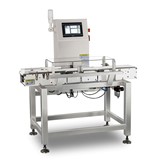
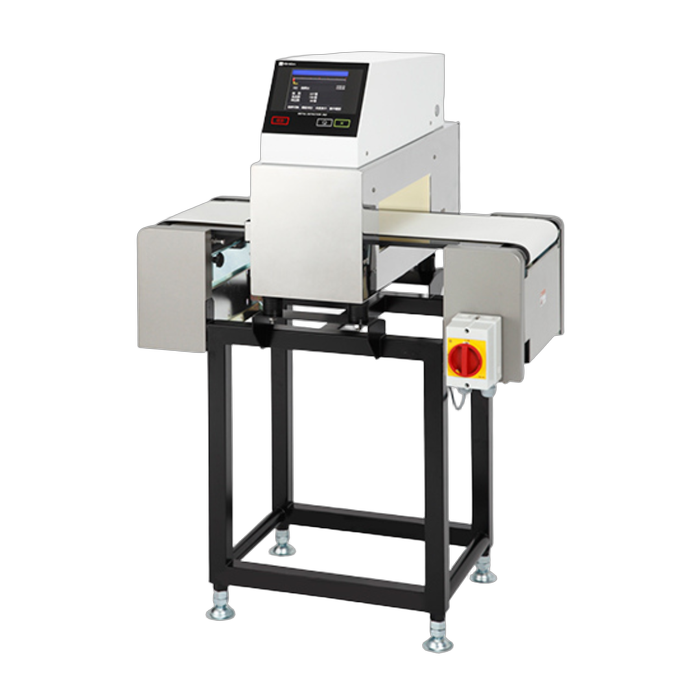
Conveyor metal detector systems are the standard for finished or packaged product inspection. They handle the widest range of product formats and integrate with automatic rejection systems that remove individual contaminated items without stopping the line.
Gravity fall systems achieve higher sensitivity because the product stream passes through a smaller, tighter aperture. They suit bulk ingredients moving vertically through pipes or chutes — a configuration where a conveyor system simply can't be used.
Many facilities run both — gravity detection at ingredient intake or post-milling, and conveyor detection at final packaged product inspection. This two-point approach catches contamination introduced at both ends of the process. Combination units that integrate weight verification with metal detection can also reduce line footprint where dual compliance obligations apply — see how checkweigher and metal detector systems compare for this configuration.
Key specifications buyers should evaluate
| Specification | Typical Range | Buyer Consideration |
|---|---|---|
| Ferrous sensitivity | From 0.8mm (gravity) / 1.5mm (conveyor) | Easiest contaminant to detect — don't use this figure alone to compare systems. |
| Stainless steel sensitivity | From 1.5mm (gravity) / 2.0mm (conveyor) | Most relevant figure for food processing environments. Always request this at your product's moisture level. |
| Aperture size | Custom to product | Gravity systems use smaller apertures — the primary reason for their sensitivity advantage. Size conveyor apertures to your largest product format. |
| Product effect | High in wet/saline products | Meat, fresh cheese and marinated products generate significant interference. Multi-frequency systems compensate; single frequency does not. |
| Reject confirmation | System-dependent | Verify the contaminated product actually left the line — not just that an ejection was triggered. |
| IP rating | IP65–IP69K | Confirm IP69K covers the full system including reject mechanism, not just the detector head. |
Technology or configuration options
| Factor | Single Frequency | Multi-Frequency |
|---|---|---|
| Dry product performance | Good | Good |
| Wet / high-moisture performance | Reduced sensitivity | Significantly better |
| Stainless steel sensitivity | Standard | Higher |
| Cost premium | None — standard | $5,000–$10,000 higher |
| Best application | Dry snacks, flour, grain, confectionery | Meat, dairy, fresh produce, marinated products |
Choose single frequency for dry, low-moisture products — biscuits, flour, dry cereals and confectionery all perform reliably without paying the multi-frequency premium.
Choose multi-frequency for any product with significant moisture or salt content. Sensitivity loss from product effect on a single frequency system inspecting fresh meat or wet cheese can render it unable to meet HACCP detection thresholds. This is not a place to economise.
Costs in Australia
| Category | Price Range (AUD, 2026) | Typical Configuration |
|---|---|---|
| Gravity fall — entry | $8,000–$12,000 | Standard aperture, manual reject, dry ingredients |
| Gravity fall — industrial | $12,000–$18,000 | Larger throughput, pneumatic diverter, hygienic build |
| Conveyor — mid-range | $20,000–$30,000 | Auto reject, standard hygienic build, moderate speed |
| Conveyor — advanced | $30,000–$45,000+ | Multi-frequency, high-speed, full washdown, data logging |
| Combination detect/checkweigh | $35,000–$60,000+ | Inline weight verification plus metal detection |
Running costs are low for both types — energy draw is under 500W for most units. Annual calibration costs $500–$2,000 depending on your food safety program. Conveyor belt replacement adds $500–$1,500 every 2–4 years. The real cost variable is downtime — a detection failure on a high-speed food line costs more per hour than the annual service contract. Local technician availability and in-country spare parts should be weighted as seriously as purchase price. Compare verified food metal detector suppliers in Sydney to assess local service coverage before committing to a system.
Australian compliance requirements
- Metal detection is commonly designated a Critical Control Point (CCP) under HACCP programs required by FSANZ food safety standards
- BRCGS and SQF standards require documented validation at defined intervals — typically every 30–60 minutes of production
- Test pieces must be certified and traceable — uncertified test pieces do not satisfy audit requirements
- Export-registered meat processors must meet AQIS requirements including documented metal detection procedures
- WHS obligations under the Work Health and Safety Act 2011 apply to installation, guarding and operator training
- Washdown construction requirements for wet processing environments are governed by AS 4674
For a detailed breakdown of HACCP designation, audit documentation requirements and compliance standards applicable to both system types, see the safety and compliance guide for metal detection systems.
Supplier comparison checklist
| Factor | What to Ask |
|---|---|
| System type recommendation | Based on my product format and installation point, which system do you recommend and why? |
| Stainless steel sensitivity | What is the SS sensitivity for my specific product at my line speed — tested with my actual product? |
| Product effect management | How does this system handle product effect for my moisture and salt levels? |
| Reject confirmation method | How does the system confirm the contaminated product has physically left the line? |
| IP rating scope | Does the IP rating cover the complete system including reject mechanism? |
| Test piece certification | Are supplied test pieces certified and traceable to national measurement standards? |
| Validation logging | Does the system support digital test piece logging for audit documentation? |
| Service coverage | Do you have technicians in my state, and what is the response time for breakdowns? |
Frequently asked questions
Which system achieves higher sensitivity — conveyor or gravity fall? Gravity fall systems typically achieve higher sensitivity because the product stream passes through a smaller aperture, concentrating the detection field. Detection from around 0.8mm for ferrous metals is achievable in well-configured gravity systems versus around 1.5mm for conveyor systems. If maximum sensitivity is the priority and your product is free-flowing bulk material, gravity fall is the better specification.
What is product effect and why does it matter? Product effect is signal interference generated by the food product itself as it passes through the detection field. High moisture, salt, temperature and density all contribute. Wet meat, fresh cheese and marinated products generate significant product effect that reduces sensitivity on single frequency systems — sometimes below HACCP thresholds. Multi-frequency systems filter product effect and maintain sensitivity. They are the correct specification for any high-moisture conveyor line application.
Where should each system be installed? Gravity fall systems sit between processing stages — after milling, before blending, or at vertical transfer points. Conveyor systems go after packaging or at the final inspection point before palletising. Running both gives you detection coverage at ingredient intake and at finished product — your HACCP analysis should identify the highest-risk contamination points and specify accordingly.
When should X-ray inspection replace metal detection? When your packaging includes metalised film, foil trays or aluminium lidding — materials that interfere with conventional metal detectors. X-ray food inspection systems also detect glass, dense plastics and bone fragments that metal detectors cannot. The trade-off is cost — typically $40,000–$100,000+ for food production systems. Where product is in standard film packaging and metal contamination is the primary risk, a well-specified metal detector remains the more cost-effective solution.
Do both systems require the same compliance documentation? Yes. Both require test piece validation at defined intervals, certified and traceable test pieces, maintenance records and corrective action documentation. Validation frequency is set by your food safety program — typically every 30–60 minutes under BRCGS and SQF standards. Digital logging that automatically records test results simplifies audit preparation and is worth specifying on either system type. For a full overview of maintenance and calibration obligations under Australian food safety programs, see the metal detector maintenance and calibration guide.
Summary
- Product format determines system type — packaged discrete items need conveyor; bulk powders and grains need gravity fall
- Gravity fall achieves higher sensitivity due to smaller apertures — typically from 0.8mm versus 1.5mm for conveyor
- Multi-frequency is required for high-moisture or high-salt products — single frequency is adequate for dry goods
- Many facilities need both system types — HACCP analysis should determine installation points
- Certified and traceable test pieces are non-negotiable under BRCGS and SQF audit standards
Ready to source your food metal detector?
Don't waste time chasing individual suppliers. IndustrySearch gives you direct access to verified Australian food metal detector suppliers — compare models, specs and pricing in one place, then request quotes from suppliers best matched to your operation.
- Compare models — filter by capacity, configuration and region
- Request quotes — contact multiple verified suppliers with a single enquiry
- Contact suppliers directly — speak to specialists who service your state
Compare Food Metal Detectors on IndustrySearch Now →