Key Takeaways
| Factor | VFFS (Vertical Form Fill Seal) | Flow Wrap (Horizontal) |
|---|---|---|
| Primary application | Powders, granules, snacks, frozen vegetables | Bars, biscuits, fresh produce, irregular solid items |
| Pack format | Pillow bag, gusset, quad seal, stick pack | Fin seal wrap, three-sided seal, pillow wrap |
| Speed range | 20–200 bags/minute depending on product | 50–300 packs/minute depending on product |
| Price range (new) | $35,000–$350,000 AUD | $30,000–$280,000 AUD |
| Footprint | Vertical — compact floor area | Horizontal — longer line footprint |
| Product fragility handling | Moderate — gravity feed can damage fragile items | High — gentle horizontal product placement |
| Typical film types | Laminate, PE, PP, foil, compostable | OPP, PE, laminate, compostable |
| Best for | Free-flowing products, high-volume pouching | Solid formed products, gentle handling required |
Pricing reflects 2026 Australian market conditions.
→ Ready to compare machines? Browse VFFS machines on IndustrySearch or flow wrappers to see current models and pricing from verified Australian suppliers.
What is the difference between a VFFS and Flow Wrap machine?
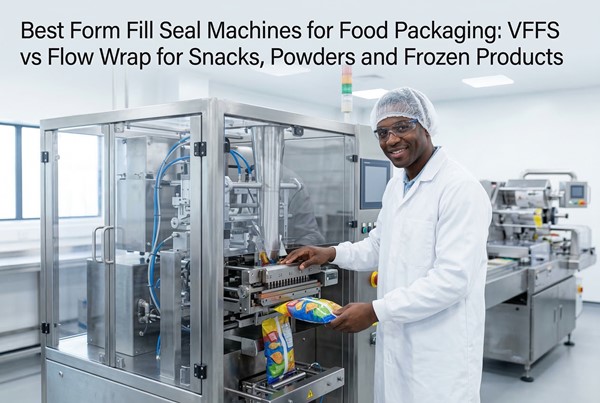
A VFFS machine forms a film tube vertically around a forming collar, fills it from above and seals each pack — while a flow wrap machine feeds product horizontally onto a flat film web and wraps it longitudinally with end seals. VFFS is the Australian standard for free-flowing products including powders, granules and snacks, while flow wrap is standard for solid, formed and fragile items including bars, biscuits and portioned frozen products. New machines range from $30,000 to $350,000 AUD depending on machine type, motion system and integration requirements.
Why This Decision Matters
VFFS and flow wrap are the two dominant form fill seal technologies in Australian food manufacturing. They share the same core function but are engineered for fundamentally different product types. Specifying the wrong machine creates ongoing product damage, seal failure, line inefficiency and packaging waste.
The right choice depends on three questions:
- What is the product's physical form? Free-flowing, granular or powder — or solid, formed and fragile?
- What pack format does the market require? Stand-up pouch, pillow bag or individually wrapped bar?
- What is the required throughput? Pack speed determines whether entry-level or high-spec equipment is justified.
Free-flowing products that can drop vertically into a bag — specify VFFS. Solid, formed or fragile products requiring horizontal placement — specify flow wrap.
VFFS Machines: Applications and Configurations
VFFS is the standard specification for any product dispensed by weight or volume into a vertical tube.
VFFS suits: chips, popcorn, nuts, puffed snacks, flour, spices, protein powder, coffee, rice, grains, seeds, pet food, frozen vegetables, lollies and gummies.
VFFS bag formats: pillow bag, gusseted bag, quad seal / block bottom, stick pack.
VFFS does not suit fragile solid items where gravity drop and vertical sealing cause product breakage or deformation.
Flow Wrap Machines: Applications and Configurations
Flow wrap feeds product horizontally onto a flat film web without dropping, making it the standard for fragile and formed items.
Flow wrap suits: snack bars, muesli bars, chocolate bars, biscuits, fresh produce, fish portions, meat cuts, formed frozen meals and bakery items.
Flow wrap does not suit free-flowing products — powders, granules, small pieces — which cannot be placed onto a horizontal film web without containment.
Speed, Throughput and Costs
| Category | VFFS | Flow Wrap |
|---|---|---|
| Entry (intermittent, under 30 packs/min) | $35,000–$80,000 | $30,000–$70,000 |
| Mid-range (continuous, 30–80 packs/min) | $80,000–$180,000 | $70,000–$160,000 |
| High-speed (servo, 80–200 packs/min) | $180,000–$350,000 | $160,000–$280,000 |
| Used / refurbished | $15,000–$80,000 | $12,000–$70,000 |
Intermittent motion machines stop the film during sealing — lower cost, simpler maintenance, suited to lower-volume production. Continuous motion machines seal while the film moves — suited to high-volume operations where line stoppage is costly.
Total cost of ownership extends well beyond machine price. Key additional costs:
- Multihead weigher (VFFS) — $25,000–$120,000
- Infeed conveyor system (flow wrap) — $8,000–$40,000
- Film cost — $3,000–$15,000 per month at mid-volume
- Annual servicing — $3,000–$8,000 for most mid-range machines
- Changeover tooling — $2,000–$12,000 per format change
→ If you're at the budget-setting stage, request quotes from VFFS suppliers or flow wrapper suppliers on IndustrySearch to get line-specific pricing before committing to a configuration.
Film and Packaging Material Considerations
| Film Type | VFFS | Flow Wrap | Notes |
|---|---|---|---|
| OPP | ? | ? Strong | Low cost, good clarity, standard for snacks |
| PE / LDPE | ? | ? | Good seal strength, suited to frozen |
| Laminate (multi-layer) | ? Strong | ? | Barrier properties for extended shelf life |
| Foil laminate | ? | ? | Maximum barrier — coffee, protein powder |
| Compostable film | ? | ? | Narrower seal window — confirm compatibility |
| Shrink film | ? | ? Strong | Requires downstream shrink tunnel |
Compostable film adoption is increasing across Australian food manufacturers. Confirm seal jaw compatibility and temperature parameters before specifying — seal windows are narrower and machine settings require adjustment.
Australian Compliance and Food Safety Requirements
- FSANZ Food Standards Code — film and adhesive materials must comply with food contact requirements
- HACCP integration — cleanability and hygienic design are critical specification criteria
- AS 1677 and relevant cold chain standards apply for frozen product packaging lines
- Weights and Measures Act — weigher accuracy and seal integrity directly affect net content compliance
- Allergen control — machine design must allow full washdown between allergen-containing product runs
- TGA — additional manufacturing requirements apply if the line is used for therapeutic goods or supplements
Supplier Comparison Checklist
| Factor | What to Ask |
|---|---|
| Product compatibility | Validated for my product — weight, density, fragility, moisture content? |
| Speed at my pack size | Demonstrated speed at my pack format and target weight — not rated maximum? |
| Film compatibility | Compatible film types and thicknesses — including compostable? |
| Changeover time | Format changeover duration — how many SKUs can I run? |
| Hygienic design | Food-grade cleanability — wash-down rated? |
| Integration | Upstream and downstream equipment required — weigher, conveyor, date coder? |
| Local service | Australia-based technicians? Average breakdown response time? |
| Spare parts | Common wear parts stocked locally — sealing jaws, belts, forming collars? |
| Demonstration | Can I run my product on a test machine before purchase? |
→ Use this checklist when comparing verified Australian suppliers on IndustrySearch — request quotes from multiple suppliers simultaneously and compare service coverage alongside machine specs.
Why Local Servicing Matters in Australia
Packaging line downtime is one of the highest-cost events in food manufacturing. A line stopped waiting for an overseas technician or internationally sourced spare part can cost more per day in lost production than the annual service contract. Verify that any supplier maintains Australia-based technicians, holds critical wear parts in-country, and has active reference sites in Australian food manufacturing operations.
A machine that performs well in a European or North American factory may require different film specifications, electrical configurations and compliance documentation for the Australian market. Sourcing from a supplier with verified Australian installation experience reduces commissioning risk and integration delays significantly.
Frequently Asked Questions
Which machine is better for snack food packaging — VFFS or flow wrap? For chips, popcorn, nuts and puffed snacks, VFFS with a multihead weigher is the industry standard — high speed, accurate weighing and flexible bag formats. For bars, individually wrapped biscuits and fragile snacks, flow wrap is correct — horizontal placement eliminates the drop damage VFFS gravity feed causes on fragile items. Many snack manufacturers operate both machine types for different SKUs within the same product range.
Can VFFS machines handle frozen products? Yes — VFFS is widely used for frozen vegetables, frozen fruit and other free-flowing frozen products. Key specification considerations are low-temperature film performance, anti-static film handling and seal jaw heating capacity. For formed frozen products — fish fillets, meat portions, meal components — flow wrap is typically the better specification because horizontal placement prevents product damage on the line.
What is the minimum production volume that justifies a form fill seal machine? Operations producing more than 500–1,000 packs per day can generally justify entry-level FFS equipment against the cost of manual packaging labour. Below this volume, contract packaging is typically more cost-effective. At 2,000–5,000 packs per day, mid-range continuous motion equipment becomes financially justified on labour displacement alone. Confirm the break-even calculation with your supplier using your specific pack rate, labour cost and shift structure.
How important is multihead weigher integration for VFFS? For throughput above 40–50 packs per minute, multihead weigher integration is effectively mandatory. A 10–16 head weigher combines product combinations to hit target weight within tight tolerance at the required cycle rate. Without it, speed is constrained and weight accuracy suffers. Budget $25,000–$120,000 for the weigher in addition to the VFFS machine price.
What to Include in Your IndustrySearch Quote Request
- Product state and characteristics — free-flowing, solid/formed or fragile; weight per unit, moisture content and temperature requirements
- Required throughput — target packs per minute at your nominated pack size and weight
- Pack format and film type — pillow bag, gusseted, flow wrap or stick pack; laminate, foil, compostable or shrink
- Upstream and downstream integration — equipment already in place and what needs to be supplied as part of the line
Summary
- VFFS is the standard for free-flowing products — powders, granules and snacks — with flexible bag formats and multihead weigher integration
- Flow wrap is the standard for solid, formed and fragile products — bars, biscuits, fresh and frozen portions
- Budget 30–60% above machine price for full line integration including weigher, conveyor and changeover tooling
- Compostable film is viable on both machine types — confirm seal jaw compatibility before specification
- Australian food safety compliance — FSANZ, HACCP and allergen control must be built into specification, not added after purchase
- Verify local service capability — Australia-based technicians and locally stocked parts are a primary procurement criterion
Ready to Source Form Fill Seal Equipment?
Don't waste time contacting suppliers individually. IndustrySearch connects you with verified Australian packaging machinery suppliers — compare VFFS and flow wrap machines, specifications and pricing in one place.
- Compare machines by product type, speed and configuration
- Request quotes from multiple verified suppliers
- Speak directly with suppliers servicing your state
-160x160-state_article-rel-cat.png)